
A king’s thank-offering in granite, completed a thousand years ago and still in worship.
- Deity
- Shiva as Peruvudaiyar, the great lord
- Where
- Thanjavur தஞ்சாவூர்
- Known as
- A UNESCO World Heritage Site, one of the Great Living Chola Temples
- Oldest record
- 1003–1010
௧ The legend
The old woman’s stone
When Rajaraja Chola set out to build the tallest temple of his age, the whole kingdom was asked to give. An old woman of the city, Azhagi, had nothing but a stone in her yard, and she offered it.
The story goes that the king’s builders, needing a stone for the very top, found hers fitted best. So the capstone over the god is a widow’s gift, and the king’s pride is held up by her devotion.
Another story is told by every guide: that the tower’s shadow never falls on the ground at noon. It does fall, of course. But the telling says something true about how the people of Thanjavur see their temple.
As the story is told at the temple. Legends vary in the telling.
௨ Across the centuries
Built by many hands, tier upon tier
1003–1010
Rajaraja Chola I
Built in seven years under the architect Kunjara Mallan Raja Rama Perunthachan, and consecrated in 1010.
11th century
Chola inscriptions
The walls record gifts of gold and land, and the names of four hundred temple dancers.
16th–17th century
Thanjavur Nayaks
The great Nandi mandapam and new paintings, laid over the older Chola frescoes.
1987
UNESCO
Inscribed as a World Heritage Site.
2010
A thousand years
The millennium of the temple is celebrated with a thousand dancers in the courtyard.
௩ What to look for
When you stand inside
The vimana
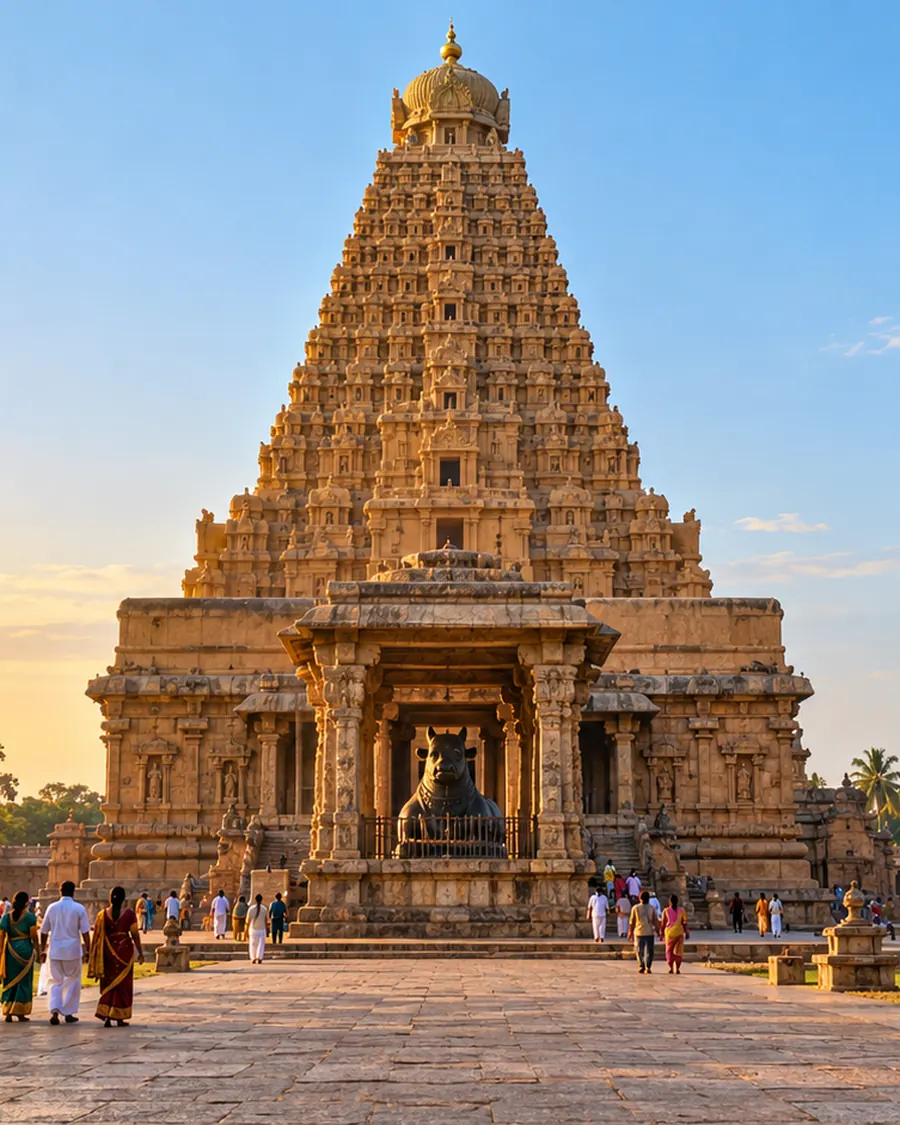
About sixty-six metres of granite over the sanctum, in a land with no granite quarry nearby.
The capstone
A great domed stone said to weigh about eighty tonnes, raised, the story goes, along an earth ramp kilometres long.
The Nandi
One of the largest stone bulls in India, carved from a single rock.
Chola frescoes
Thousand-year-old paintings found beneath later work in the passage around the sanctum.
௪ The temple’s year
The festivals that fill it
- சித்திரைChithiraiApr–May
- வைகாசிVaikasiMay–Jun
- ஆனிAaniJun–Jul
- ஆடிAadiJul–Aug
- ஆவணிAavaniAug–Sep
- புரட்டாசிPurattasiSep–Oct
- ஐப்பசிAippasiOct–Nov
- கார்த்திகைKarthigaiNov–Dec
- மார்கழிMargazhiDec–Jan
- தைThaiJan–Feb
- மாசிMaasiFeb–Mar
- பங்குனிPanguniMar–Apr
Aippasi Oct–Nov
Sadhaya Vizha
Rajaraja’s birth star, celebrated in the temple he built.
Maasi Feb–Mar
Maha Shivaratri
A night of worship, with dance in the courtyard.
Festival dates follow the temple’s own calendar and change each year. We confirm them before you travel.
௫ Going there
Journeys that bring you here
- Most Tamil Nadu temples close around midday and reopen in the late afternoon. Each day keeps temples for the morning and evening and puts the road in between.
- Dress traditionally and modestly. Footwear is left outside every temple.
- Darshan arrangements differ from temple to temple and can change on festival days. We confirm what is possible at each one before you travel.
To stand here yourself, with the car, the stay, the guide and the darshan arranged, ask us to plan your journey. We call you back and listen first.
Draft Legends and history are retold from widely published sources and await review. Timings, dress code and special-entry arrangements are published once each fact has a source and a review date.