Here the goddess is queen first. The city was hers before the god came to marry her.
- Deity
- Meenakshi, with Shiva as Sundareswarar
- Where
- Madurai மதுரை
- Known as
- The heart of the oldest living city of the Tamils
- Oldest record
- 7th century

௧ The legend
The princess born from fire
The Pandya king Malayadhwaja and his queen Kanchanamalai prayed for a child, and from the sacrificial fire stepped a girl of three. She had three breasts, and a voice from the sky told the frightened parents that the third would vanish when she met the one she was to marry.
Raised as an heir, the girl Thadathagai grew into a warrior queen. She ruled Madurai and rode out to conquer the eight directions, until on Mount Kailash she faced Shiva himself. At the sight of him her third breast vanished, and she knew.
Shiva came to Madurai as Sundareswarar, the beautiful lord, and married her in the city. Vishnu, her brother, came to give the bride away. The wedding is still celebrated every spring, and the temple remains the goddess’s house: by custom, pilgrims see Meenakshi before they see Sundareswarar.
As the story is told at the temple. Legends vary in the telling.
௨ Across the centuries
Built by many hands, tier upon tier
7th century
Pandya kings
The shrine is sung in the Tevaram hymns; Madurai is already the Pandya capital and the seat of Tamil learning.
1311
Raid from the north
The city is sacked by Malik Kafur’s army and much of the old temple is lost.
1569
Ariyanatha Mudaliar
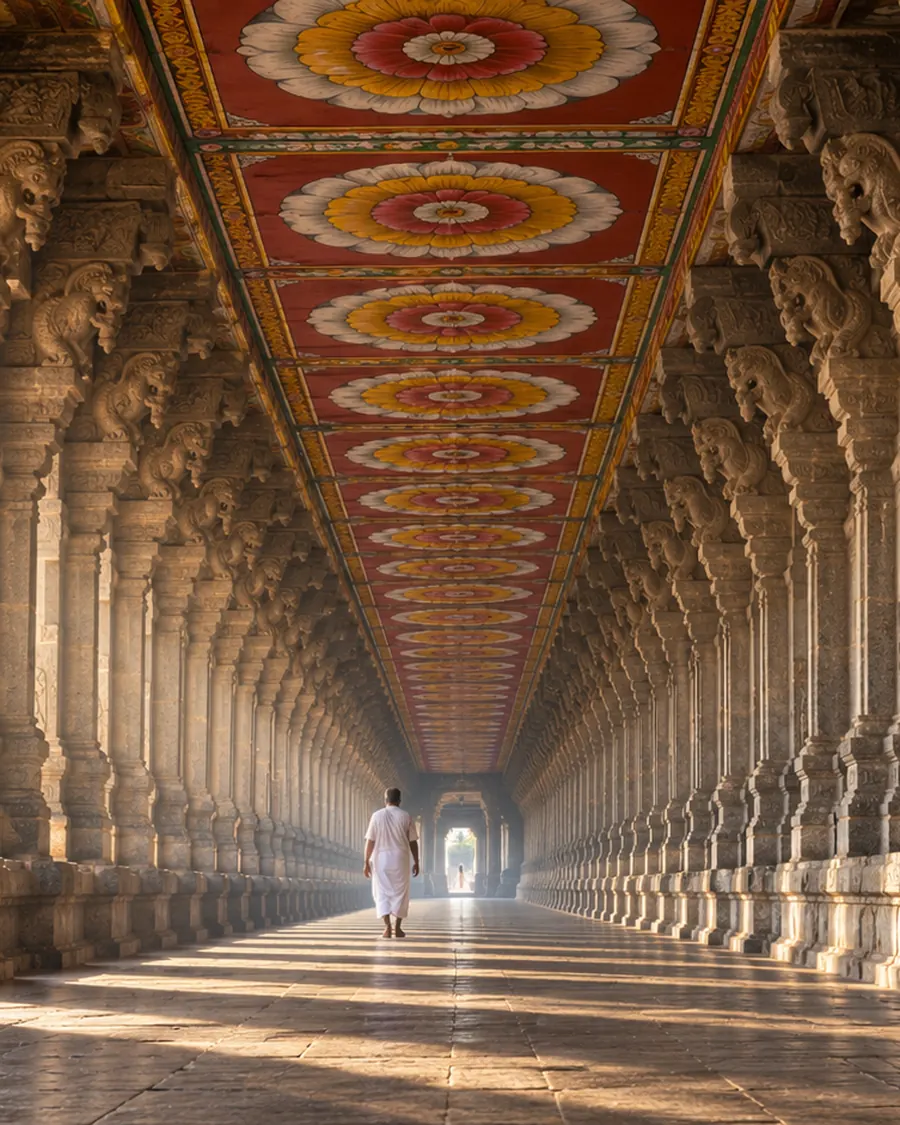
The Hall of a Thousand Pillars is raised, its carved columns set in perfect rows.
1623–1659
Thirumalai Nayak
The great Nayak rebuilding: mandapams, the tank colonnades and the towering gopurams that define the skyline.
Today
A living temple
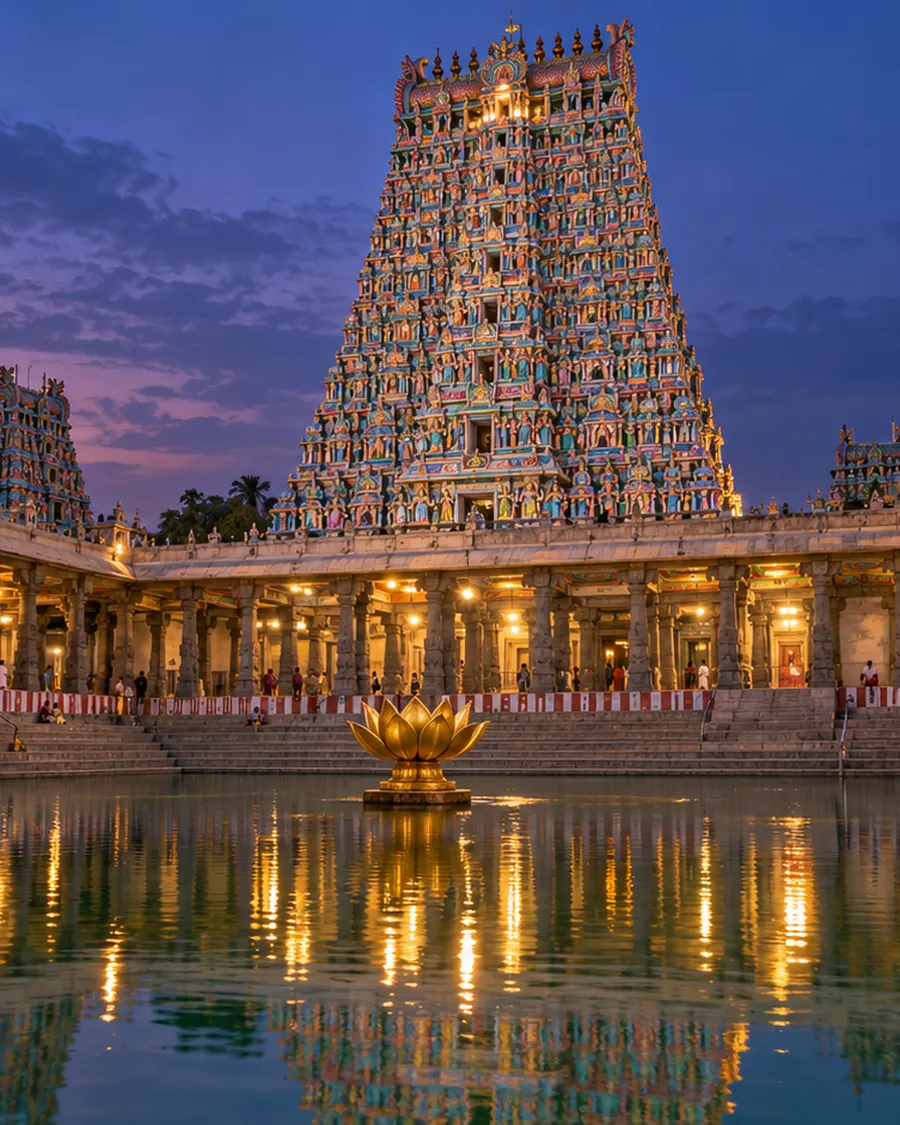
Fourteen gopurams, the tallest about fifty-two metres, repainted in every renewal and visited by tens of thousands a day.
௩ What to look for
When you stand inside
Fourteen gopurams
Every tier is crowded with painted stucco figures: gods, sages, beasts and dancers in thousands.
The Golden Lotus Tank
Tradition says Tamil poems were floated here to be judged: works of worth floated, the rest sank.
The Hall of a Thousand Pillars
Look down any line of columns from any angle and they stand in a straight row.
The musical pillars
Slender stone columns that ring with different notes when tapped.
௪ The temple’s year
The festivals that fill it
- சித்திரைChithiraiApr–May
- வைகாசிVaikasiMay–Jun
- ஆனிAaniJun–Jul
- ஆடிAadiJul–Aug
- ஆவணிAavaniAug–Sep
- புரட்டாசிPurattasiSep–Oct
- ஐப்பசிAippasiOct–Nov
- கார்த்திகைKarthigaiNov–Dec
- மார்கழிMargazhiDec–Jan
- தைThaiJan–Feb
- மாசிMaasiFeb–Mar
- பங்குனிPanguniMar–Apr
Chithirai Apr–May
Chithirai Thiruvizha
The divine wedding, and Kallazhagar’s arrival at the Vaigai river. The whole city takes to the streets.
Thai Jan–Feb
Float festival
The deities are carried on a lit float across the great Teppakulam tank.
Purattasi Sep–Oct
Navaratri
Nine nights of the goddess, with a different alankaram each evening.
Festival dates follow the temple’s own calendar and change each year. We confirm them before you travel.
௫ Going there
Journeys that bring you here
- Most Tamil Nadu temples close around midday and reopen in the late afternoon. Each day keeps temples for the morning and evening and puts the road in between.
- Dress traditionally and modestly. Footwear is left outside every temple.
- Darshan arrangements differ from temple to temple and can change on festival days. We confirm what is possible at each one before you travel.
To stand here yourself, with the car, the stay, the guide and the darshan arranged, ask us to plan your journey. We call you back and listen first.
Draft Legends and history are retold from widely published sources and await review. Timings, dress code and special-entry arrangements are published once each fact has a source and a review date.